What 1,892 Font Files Say About Their Licence — 2026 Audit
The licence explainer covers what the SIL OFL permits. This is the other half: we opened every font file on one ordinary Linux system — 1,892 of them — and read the licence out of each one. The result is a picture of how open type actually reaches a machine, and where the paperwork quietly runs out.
Measured 5 September 2026 · Last updated 5 September 2026 · OpenGlyph Editorial
What was measured, and when. On 5 September 2026 we read the OpenType name table of every unique font file present on one AlmaLinux 9 system — 1,892 files, as listed by fc-list. Fields 13 (licence text) and 14 (licence URL) were recorded verbatim; nothing was inferred from a copyright line.
Where a file stated no licence, the owning distribution package was queried with rpm -qf and its declared licence recorded instead. Script coverage was taken the same day with fc-list :charset=…. Every figure on this page comes from that one run and can be reproduced with the commands below.
How this was measured
A font file can carry its own licence. The OpenType name table has two fields reserved for it: ID 13, the licence text, and ID 14, a URL. Anyone can read them without special tooling.
We read those two fields from every unique file fc-list reported, and classified only on what those fields say. A copyright line is not a licence and was not treated as one — that distinction matters, and it changed our first result.
What 1,892 font files say
| Licence stated inside the file | Files | Share | Families |
|---|---|---|---|
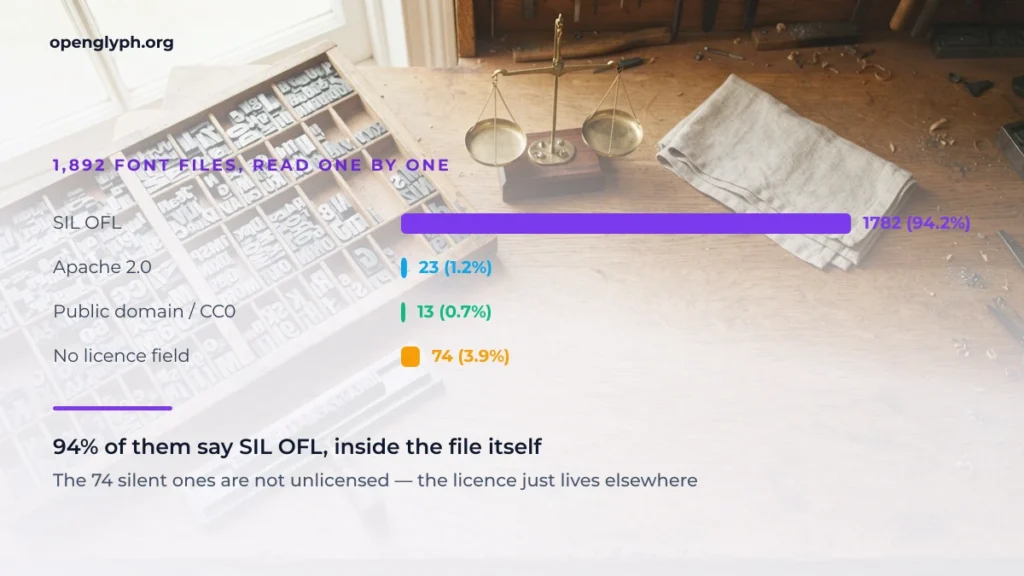
| SIL OFL | 1782 | 94.2% | 1407 |
| Apache 2.0 | 23 | 1.2% | 13 |
| Public domain / CC0 | 13 | 0.7% | 4 |
| No licence field at all | 74 | 3.9% | — |
Ninety-four percent of the files on this machine declare the SIL Open Font License, spread across 1,407 families. That is not a survey of the world’s typefaces; it is a measure of what a general-purpose system installs by default. The answer is: almost entirely OFL.
The remainder is small and recognisable. Apache 2.0 covers the Droid families and Open Sans. The public-domain-style entries are the DejaVu family, descended from Bitstream Vera.
The 74 files that say nothing
Seventy-four files — 3.9% — carry no licence field at all. They are not unlicensed. The licence simply lives somewhere else, and you have to know to look.
| Distribution package | Licence the package declares | Files |
|---|---|---|
urw-base35-nimbus-sans-fonts |
AGPLv3 | 16 |
urw-base35-c059-fonts |
AGPLv3 | 8 |
urw-base35-nimbus-mono-ps-fonts |
AGPLv3 | 8 |
urw-base35-nimbus-roman-fonts |
AGPLv3 | 8 |
urw-base35-p052-fonts |
AGPLv3 | 8 |
urw-base35-bookman-fonts |
AGPLv3 | 8 |
urw-base35-gothic-fonts |
AGPLv3 | 8 |
google-noto-sans-hanifi-rohingya-fonts |
OFL | 4 |
urw-base35-d050000l-fonts |
AGPLv3 | 2 |
urw-base35-z003-fonts |
AGPLv3 | 2 |
google-noto-sans-hanifi-rohingya-vf-fonts |
OFL | 1 |
urw-base35-standard-symbols-ps-fonts |
AGPLv3 | 1 |
Two different situations are hiding in that table.
The URW base-35 fonts (Nimbus, C059, P052, Bookman, Gothic, Z003) are the classic PostScript set. The files are silent; the distribution package declares AGPL-3.0-or-later. Those are also the .t1 Type 1 files, an older format with no name table to read in the first place.
The second case is more interesting. Noto Sans Hanifi Rohingya ships five files whose only ownership statement is Copyright 2020 Google LLC. All Rights Reserved. — no licence field. Read the file alone and it looks proprietary. The package it arrives in declares OFL.
That is the practical lesson of the whole exercise: the font file is not always the source of truth about its own licence, and “all rights reserved” in a copyright line tells you nothing about what you may do.
What the licence is actually holding up
Licensing sounds like paperwork until you check what depends on it. We took sixty writing systems, asked which installed fonts contain their letters, and looked up the licence behind each of those fonts.
| Script | Sample | Font files here | Licences behind them |
|---|---|---|---|
| Batak | ᯀ | 1 | SIL OFL (1) |
| Chakma | 𑄃 | 1 | SIL OFL (1) |
| Coptic | Ⲁ | 1 | SIL OFL (1) |
| Glagolitic | Ⰰ | 1 | SIL OFL (1) |
| Hanunoo | ᜠ | 1 | SIL OFL (1) |
| Limbu | ᤀ | 1 | SIL OFL (1) |
| Mongolian | ᠠ | 1 | SIL OFL (1) |
| Old Turkic | 𐰀 | 1 | SIL OFL (1) |
| Osage | 𐒰 | 1 | SIL OFL (1) |
| Phags-pa | ꡀ | 1 | SIL OFL (1) |
| Rejang | ꤰ | 1 | SIL OFL (1) |
| Samaritan | ࠀ | 1 | SIL OFL (1) |
| Saurashtra | ꢂ | 1 | SIL OFL (1) |
| Syloti Nagri | ꠀ | 1 | SIL OFL (1) |
| Tagalog | ᜀ | 1 | SIL OFL (1) |
| Tai Le | ᥐ | 1 | SIL OFL (1) |
| Tai Viet | ꪀ | 1 | SIL OFL (1) |
| Buginese | ᨀ | 2 | SIL OFL (2) |
| Buhid | ᝀ | 2 | SIL OFL (2) |
| Gothic | 𐌰 | 2 | SIL OFL (2) |
| Mandaic | ࡀ | 2 | SIL OFL (2) |
| New Tai Lue | ᦀ | 2 | SIL OFL (2) |
| Runic | ᚠ | 2 | SIL OFL (2) |
| Shavian | 𐑐 | 2 | SIL OFL (2) |
| Tagbanwa | ᝠ | 2 | SIL OFL (2) |
| Tibetan | ཀ | 2 | SIL OFL (2) |
| Vai | ꔀ | 2 | SIL OFL (2) |
| Yi | ꀀ | 2 | SIL OFL (2) |
| Deseret | 𐐀 | 3 | SIL OFL (2) · Apache 2.0 (1) |
| Syriac | ܐ | 3 | SIL OFL (3) |
| Javanese | ꦄ | 4 | SIL OFL (4) |
| Balinese | ᬅ | 5 | SIL OFL (5) |
| Bamum | ꚠ | 5 | SIL OFL (5) |
| Kayah Li | ꤊ | 5 | SIL OFL (5) |
| N'Ko | ߊ | 5 | Public domain / CC0 (4) · SIL OFL (1) |
| Ol Chiki | ᱚ | 5 | SIL OFL (5) |
| Sundanese | ᮃ | 5 | SIL OFL (5) |
| Tai Tham | ᨠ | 5 | SIL OFL (5) |
| Adlam | 𞤀 | 6 | SIL OFL (6) |
| Ogham | ᚁ | 7 | Public domain / CC0 (5) · SIL OFL (2) |
| Cham | ꨀ | 10 | SIL OFL (10) |
| Cherokee | Ꭰ | 10 | SIL OFL (10) |
| Meetei Mayek | ꯀ | 10 | SIL OFL (10) |
| Thaana | ހ | 10 | SIL OFL (10) |
| Lisu | ꓐ | 14 | Public domain / CC0 (9) · SIL OFL (5) |
| Tifinagh | ⴰ | 16 | SIL OFL (12) · Public domain / CC0 (4) |
| Odia | ଅ | 24 | SIL OFL (24) |
| Ethiopic | ሀ | 39 | SIL OFL (37) · Apache 2.0 (2) |
| Armenian | Ա | 51 | SIL OFL (37) · Public domain / CC0 (13) · Apache 2.0 (1) |
| Georgian | ა | 51 | SIL OFL (37) · Public domain / CC0 (13) · Apache 2.0 (1) |
| Gujarati | અ | 72 | SIL OFL (72) |
| Gurmukhi | ਅ | 74 | SIL OFL (74) |
| Kannada | ಅ | 74 | SIL OFL (74) |
| Khmer | ក | 74 | SIL OFL (74) |
| Malayalam | അ | 74 | SIL OFL (74) |
| Myanmar | က | 74 | SIL OFL (74) |
| Sinhala | අ | 74 | SIL OFL (74) |
| Telugu | అ | 74 | SIL OFL (74) |
| Tamil | அ | 76 | SIL OFL (76) |
| Lao | ກ | 123 | SIL OFL (111) · Public domain / CC0 (12) |
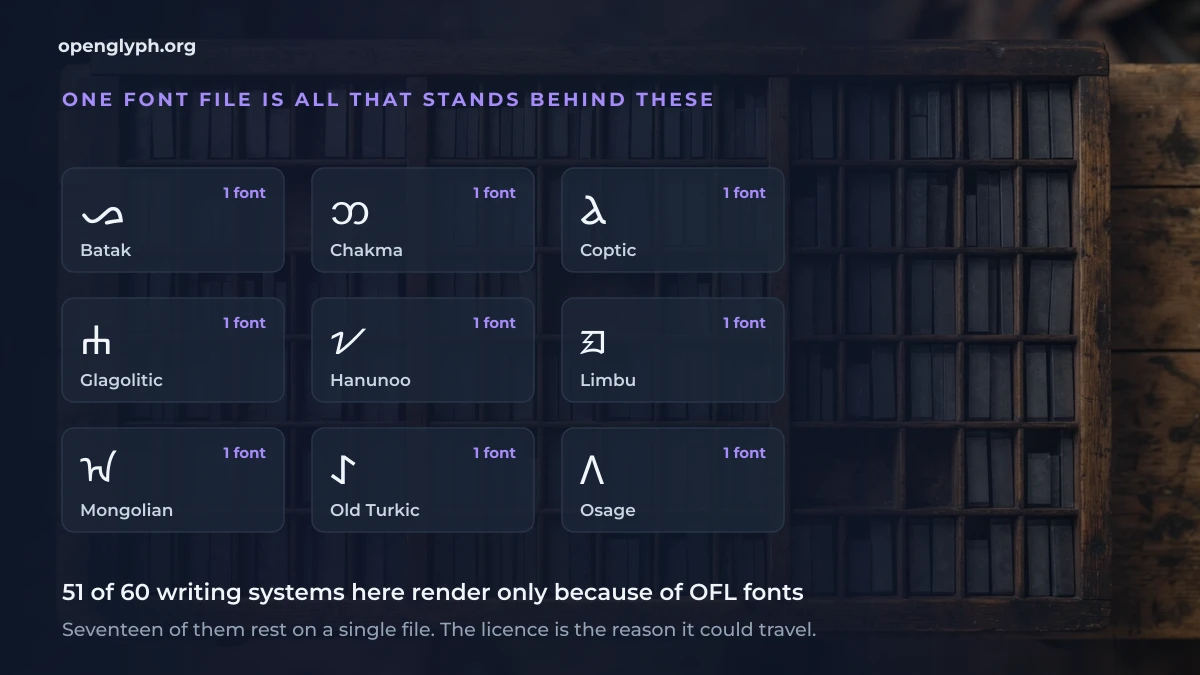
Fifty-one of the sixty are covered exclusively by fonts that state the OFL. Seventeen of them rest on a single file: Batak, Chakma, Coptic, Glagolitic, Hanunoo, Limbu, Mongolian, Old Turkic, Osage, Phags-pa, Rejang, Samaritan, Saurashtra, Syloti Nagri, Tagalog, Tai Le, Tai Viet.
Remove the OFL from that picture and most of these scripts stop rendering — not because Unicode forgot them, but because nobody would have been able to share the drawings.
The letters themselves
Four letters from each of the sixty scripts, 240 in all. Every one of them draws on this machine because someone released a font under a licence that let it travel.
The ones with a single font behind them
If that one file were not free to redistribute, this row would be empty rectangles.
Licence identifiers worth copying
If you are recording what you used — in a repository, a credits file, or a bill of materials — these are the standard short identifiers. Copy the exact string rather than writing your own wording.
Attribution lines
The OFL does not require attribution in your finished work, though it is good practice and costs nothing. These are templates; replace the placeholders with what the font’s own metadata says.
Check any font yourself
You do not need to take our numbers on trust. These commands read the same fields we did.
If the licence fields come back empty, the next place to look is the package manager, then the upstream project. In that order — the package is usually right and always easier to find.
What we would not claim
- This is one machine, not the world. It says what a general-purpose system ships, nothing more.
- A licence field is a claim by whoever built the file. It is strong evidence, not a legal opinion.
- Type 1
.t1files have no field to read. Their absence from the stated-licence count is a limit of the format, not a fact about the font. - Font counts per script are counts of files, including weights and widths of the same family.
Authorship & corrections
Compiled by the OpenGlyph editorial team. The numbers describe one machine on one day and will drift as distributions change their font packages; we would rather update the page than leave a stale figure standing.
If a licence here is recorded wrongly — especially if you maintain one of the families named — please tell us and we will correct it and note the change. Our curation and verification policy explains how we check this kind of claim.
Last updated 5 September 2026 · OpenGlyph Editorial
Community kaomoji bank
100 faces from the shared library — tap any one to copy. Invisible formatting characters and right-to-left characters have been filtered out, since both break names in ways you cannot see.
Community nickname bank
123 nicknames submitted and copied most often by readers across the network.
Questions
Does “All Rights Reserved” mean I cannot use the font?
No. It is a copyright notice, not a licence. Copyright is asserted in almost every font, including every OFL one. The licence is the separate statement of what you may do.
Why do some fonts carry no licence at all?
Sometimes the format has nowhere to put it, as with Type 1. Sometimes the build simply left the field empty. Neither means the font is free, and neither means it is restricted.
Where should I look when the file is silent?
The distribution package first — rpm -qf or dpkg -S will name it and its declared licence. Then the upstream repository, which usually ships an OFL.txt or LICENSE next to the fonts.
Is AGPL a normal licence for a font?
It is unusual but real. The URW base-35 set is released that way, with the usual understanding that embedding a font in a document does not make the document a derivative work.
Why does the OFL dominate so heavily?
Because it was written for fonts specifically, and because the Noto project — which aims to cover every script in Unicode — uses it. Most of the 1,407 families here are Noto.
Can I sell something that includes an OFL font?
Yes. You may not sell the font on its own, but bundling it into a product, a document or an app is exactly what the licence is for.