Cute kaomoji to copy and paste
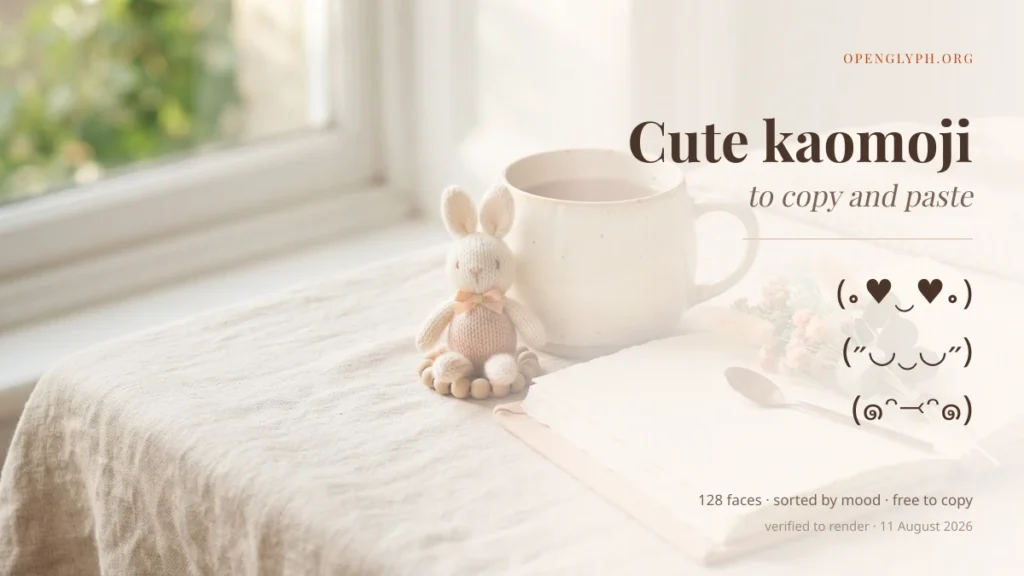
Cute kaomoji — tap any one to copy
128 entries · tap any one to copy Last checked: August 19, 2026
Every face above is a cute kaomoji you can copy with one tap and paste anywhere that accepts text. They are sorted so the softest, shyest and most huggable ones sit together — and further down we mark exactly which of them render on any device, and which need a particular font installed.
What makes a kaomoji read as cute
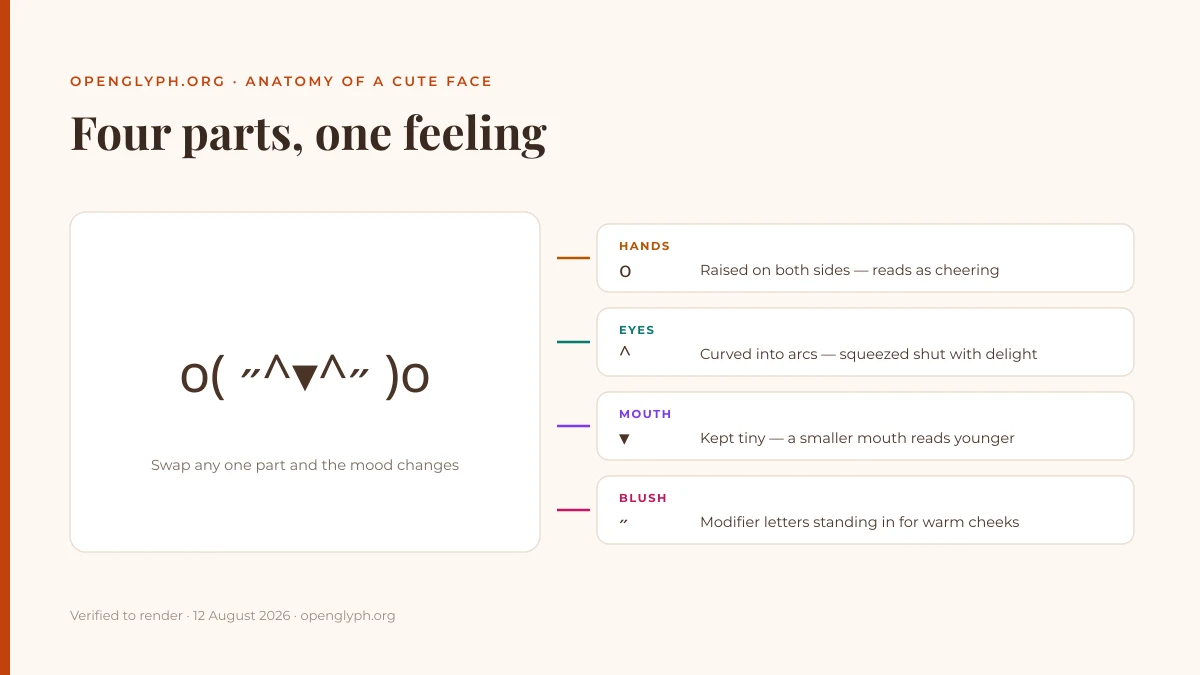
A cute kaomoji signals softness through four moving parts: rounded eyes, a small or absent mouth, blush or motion marks, and enclosing hands. Swap any one of them and the same face changes mood — which is why a library sorted by feeling is more useful than an alphabetical dump.
- Eyes carry most of it. Curved eyes like ˃ ˂ or ᵕ ᵕ read as delight; dot eyes read as calm; the same face with sharp eyes reads as annoyed.
- A smaller mouth reads younger. Cute sets favour a tiny mark, or none at all, letting the eyes do the work.
- Blush marks are the shortcut to shy. The stacked slashes in ///// are read as a flushed face across the whole genre.
- Hands and brackets add warmth. Cupped shapes wrapping the face suggest holding or offering something; outstretched ones suggest a hug.
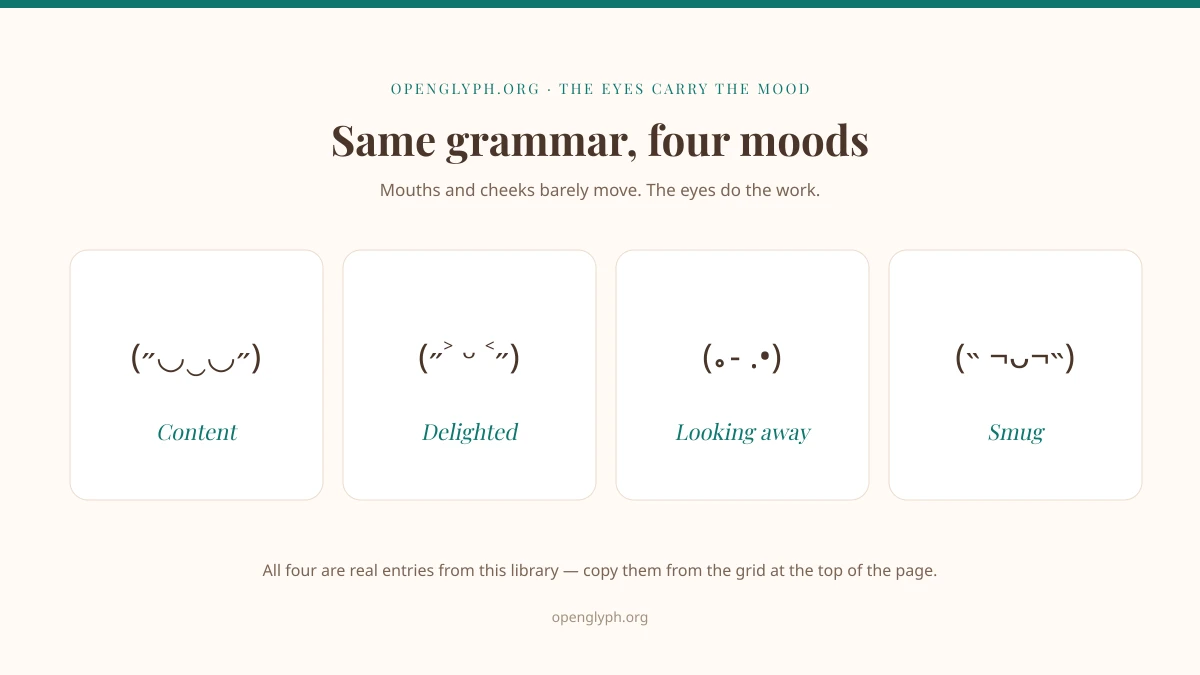
None of this is decoration for its own sake — it is a grammar, and once you can see it you can build your own. Our walkthrough on making your own kaomoji & ASCII art takes the same four parts and shows how to assemble them from scratch.
The 20 cute kaomoji that render on any device
Of the 128 faces in this set, 20 are built only from characters that ship with essentially every default font stack — twelve Unicode blocks in all, counted by how many of the 20 use each: Basic Latin (20), General Punctuation (8 — ‿ • ⁄), Spacing Modifier Letters (6 — ˶ ˘ ˃ ˂), Halfwidth and Fullwidth Forms (5), Miscellaneous Symbols (4 — the hearts ♥ ♡), then Hiragana, Mathematical Operators (≧ ≦ ∇ ∩), Geometric Shapes, Greek and Latin-1 Supplement (3 each), and Combining Diacritical Marks and Dingbats (❀ ✧) in 2 each. Those 20 are the safest choice for anywhere you cannot control the font: an older laptop, a printed document, a form that rejects unusual characters. We classified all 128 by code point on 11 August 2026. Two otherwise-safe faces are held back from this list because they use the Hangul letter ㅅ (U+3145): Korean coverage is standard on phones, but not on a stripped-down desktop font stack.
| Kaomoji | Reads as |
|---|---|
| (。♥‿♥。) | in love |
| (˶◡‿◡˶) | content, eyes closed |
| (*≧ω≦*) | squeezing with delight |
| (❀´ ˘ `❀) | flowers in hair |
| (´∇`'') | cheerful |
| ( • ̀ω•́ )✧ | determined, with a sparkle |
| ( ˶>˶˶<˶) | squinting happily |
| (づ>/////<)づ♡ | blushing hug |
| (。>\\<) | flustered |
| ( //>///<//) | deep blush |
| (⁄ ⁄•⁄ω⁄•⁄ ⁄) | bashful |
| (∩˃ ˂∩)♡ | hiding behind both hands |
| (つ.と) | tiny and quiet |
| (づ> v <)づ♡ | offering a hug |
| (。- .•) | looking away |
| (。· v ·。) ? | curious |
| o( ˶^▾^˶ )o | cheering |
| ⁄(⁄ ⁄•⁄-⁄•⁄ ⁄)⁄ | embarrassed |
| (ˊ•͈ ◡ •͈ˋ) | gentle smile |
| (⁄ ⁄>⁄~⁄<⁄ ⁄) | overwhelmed, blushing |
The other 108 are not worse — many are the prettiest in the set — they simply borrow a character from a regional script. Counting how many of the 128 faces use at least one character from each block, the most frequently borrowed are Yi Radicals (19 faces — the cupped cheeks), Unified Canadian Aboriginal Syllabics (15), Gujarati (14), Georgian (13), Thai (10) and Armenian (6); Malayalam and Tibetan appear in five faces each. On a modern phone they all render; on a stripped-down desktop font stack some will not.
How to copy and paste a cute kaomoji
Tap any face in the library at the top of this page and it goes straight to your clipboard — no download, no account. Paste it into a message, caption, comment, document or bio.
Two habits that save trouble:
- Paste as plain text when the app carries formatting. Paste and Match Style is Ctrl+Shift+V on Windows and Linux, ⌘+Shift+V on macOS. A normal paste into an email client or word processor can drag this page’s font along with the characters.
- Never retype a face by hand. Several of these carry marks that sit invisibly on top of the character before them. Retyping gets you something that looks close but is a different string; copying keeps every byte.
Why some cute faces show up as boxes
An empty box means the device received the characters correctly but has no font that can draw one of them. Nothing was lost in the copy, and the same face will usually render perfectly when you paste it into a phone app. This is a font-coverage problem, not damaged text.
It matters here because cute kaomoji lean harder on unusual characters than any other category — those cupped hands and round cheeks are borrowed from scripts most people never type in. The table above is the practical answer: when you need something guaranteed to render, take one of the 20. When you are posting to a phone-first platform, use whichever you like best.
The full mechanism, with the code points resolved character by character, is explained on OpenGlyph.org — the open kaomoji library. If you want to fix the boxes rather than avoid them, installing a broad font family such as Noto is the whole solution; our guide to SIL OFL & Creative Commons licensing covers what those open fonts let you do.
How this set is curated
This page held 128 cute kaomoji when it was last verified on 11 August 2026. Entries are stored exactly as sourced — we never strip combining marks or swap a curated face for a plainer one, because that is what turns a working kaomoji into a broken one.
Three things are removed and nothing else: exact duplicates, entries that are invisible when pasted, and faces whose mood does not belong here. That last filter is why you will not find crying, angry or shrugging faces on this page even though they came from the same sources — they live with their own moods instead. The method is written up in full on how we curate & verify.
Missing a face you use? Send it to us — maintainers check it for originality and rendering, credit you, and publish it under the terms on our content licensing page. For faces built around a heart rather than a blush, our heart kaomoji library is the neighbouring set; and if you are after the decorative marks themselves rather than faces, every heart symbol & how it renders covers those in depth.
Questions people ask
Are cute kaomoji safe to use in a username?
It depends entirely on the platform, and we cannot promise any particular string will be accepted. Message and caption fields take arbitrary text; usernames, display names and in-game nicknames are often validated against a limited character set, and those rules change without notice and differ between a service’s app and its website. Test in the field itself and read that platform’s naming rules. The 20 faces in the table above are the likeliest to pass, because they use the narrowest character range.
Why do these look different on my friend’s phone?
Because a kaomoji is drawn by whatever font the reader’s device has, not by a picture you sent. That is the opposite of an emoji, which every platform draws with its own artwork. The characters are identical on both ends; only the typeface differs.
Can I use them in something commercial?
The faces themselves are sequences of Unicode characters, not artwork, so there is nothing to license in the characters. What can carry a licence is a font or a specific artistic work — see our content licensing page for how community submissions on this site are shared. Platform and game names anywhere on this site are trademarks of their owners; OpenGlyph is not affiliated with any of them, as stated on our non-affiliation page.
What is the difference between a kaomoji and an emoticon?
You read a kaomoji upright and an emoticon sideways. (。♥‿♥。) faces you directly; :-) needs a head tilt. Kaomoji emerged in Japan in the 1980s, where the available character sets offered enough brackets and marks to build a face that stands upright.