Heart kaomoji to copy and paste
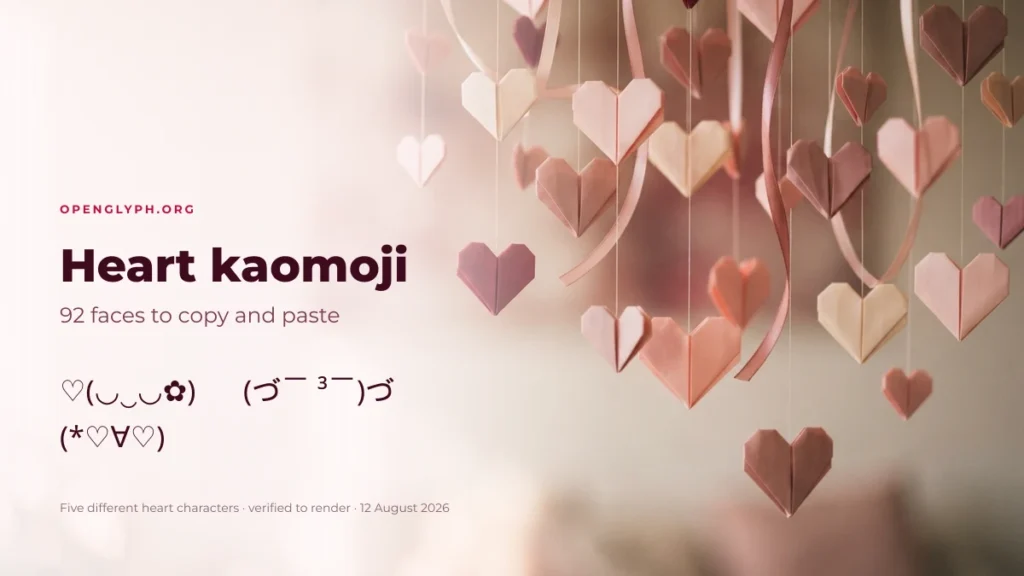
Heart kaomoji — tap any one to copy
92 entries · tap any one to copy Last checked: August 19, 2026
Almost every face above carries a heart — 90 of the 92, with the two exceptions named further down — and you can copy any of them with a single tap. What is not obvious is that they do not all use the same heart: five different characters are doing that job across this set, and they behave differently once you paste them.
Not all hearts are the same character
A heart in a kaomoji is one of a handful of Unicode characters, and the choice decides whether it stays a small text mark or turns into a full-colour picture on the reader’s screen. We resolved every entry in this set on 11 August 2026.
| Heart | Code point | What it is | How it renders | Used in |
|---|---|---|---|---|
| ♡ | U+2661 |
White heart | Text mark; takes the text colour | 65 of 92 (71%) |
| ³ | U+00B3 |
Superscript three, used as a kiss mouth | Text; in every font since Latin-1 | 16 of 92 (17%) |
| ♥ | U+2665 |
Black heart | Text mark; solid fill | 5 of 92 (5%) |
| ❤ | U+2764 |
Heavy black heart | Usually drawn as a colour emoji | 3 of 92 (3%) |
| 💕 | U+1F495… |
Colour emoji hearts | Always a picture, never text | 9 of 92 (10%) |
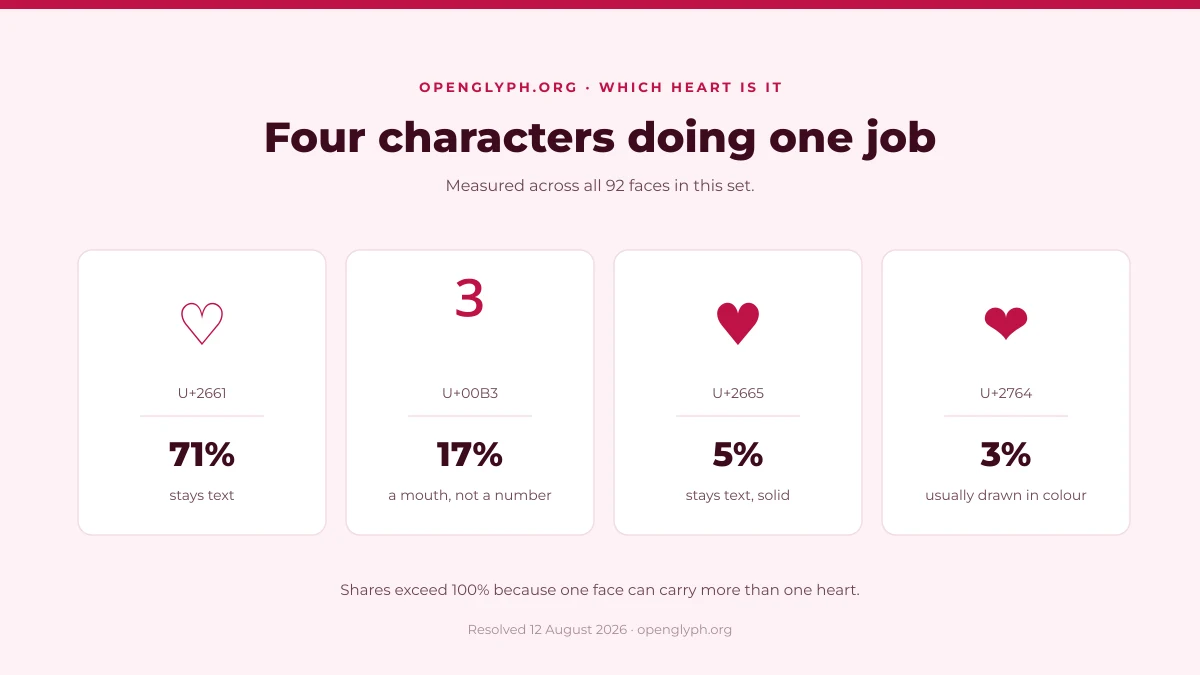
The percentages add up to more than 100 because a single face can carry more than one kind of heart.
The pattern is clear: the outlined ♡ dominates because it stays out of the way. It is a text character everywhere, it inherits the surrounding text colour, and it sits at roughly the same weight as the brackets around it — so the face still reads as a face. A filled or emoji heart pulls the eye to itself and can overpower the small marks doing the actual work.
If it is the heart symbols themselves you are after rather than faces built around them, we cover each one separately in every heart symbol & how it renders.
Why ³ is a mouth, not an exponent
³ is U+00B3, superscript three — and in 17% of this set it is being used as a puckered mouth, not a number. Read ( ˘ ³˘) as closed eyes either side of pursed lips: it is the kissing face, and it is one of the oldest borrowings in the whole genre.
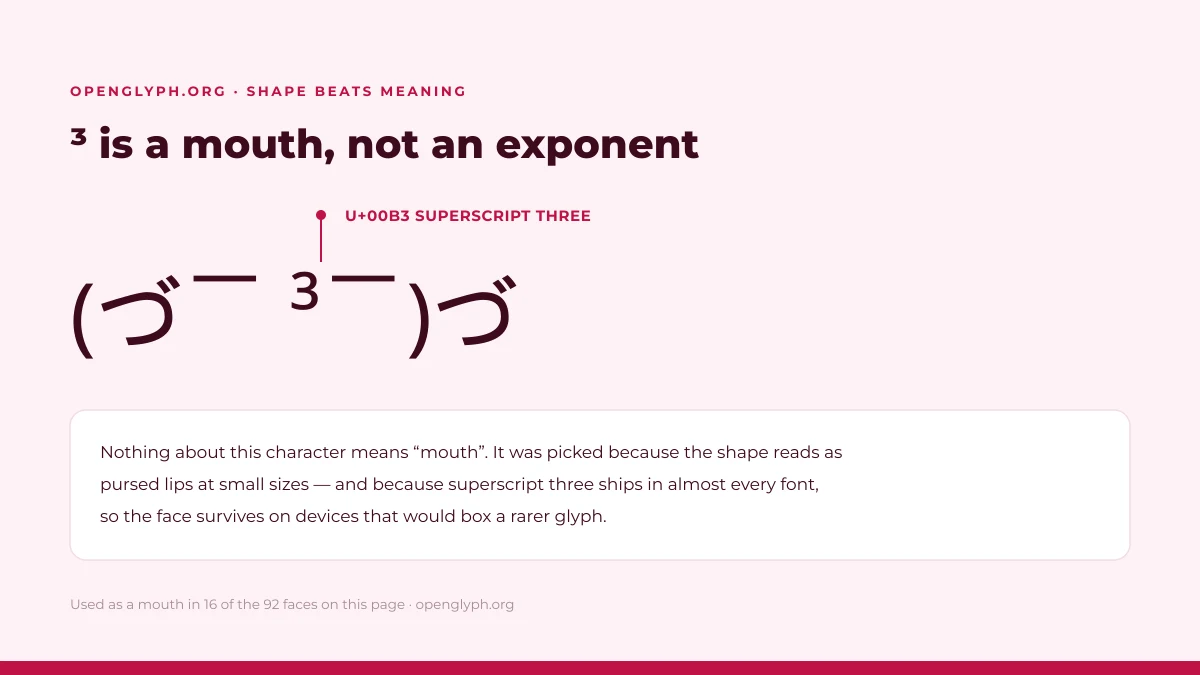
This is the single best illustration of how kaomoji actually work. Nothing about U+00B3 means “mouth” — it was chosen because its shape happens to look like one at small sizes, and because superscript three is present in Latin-1 and therefore in essentially every font ever shipped. Function follows shape, not the character’s official meaning. The same logic explains cupped hands drawn with a Gujarati digit and cheeks drawn with Yi radicals; we take that apart character by character on OpenGlyph.org — the open kaomoji library.
When a text heart turns into a colour emoji
Three characters in this set are ❤ (U+2764), and that one is a trap worth knowing about: most platforms give it emoji presentation by default, drawing it as a glossy red picture rather than a text mark. The same string can therefore look restrained on one device and loud on another.
Unicode provides two invisible characters that settle the argument — U+FE0E asks for the text form, U+FE0F asks for the emoji form. Exactly one entry in this set carries U+FE0E, deliberately pinning its heart to the text style. That invisible character is precisely the kind of thing a well-meaning “clean up” strips out, which is why we store every entry byte for byte and never normalise them.
How to copy and paste a heart kaomoji
Tap any face in the library at the top and it is on your clipboard. Two things worth knowing:
- Paste as plain text if the app carries formatting. Ctrl+Shift+V on Windows and Linux, ⌘+Shift+V on macOS. A plain paste keeps the characters without dragging this page’s font along.
- Expect the heart to change colour, not shape. A text heart takes the colour of the surrounding text, so the same face is black in a document and white in a dark-mode chat. That is normal and means nothing is broken.
How to type ♡ without copying it
To type the outline heart ♡ (U+2661) from a keyboard: in Microsoft Word, type 2661 and press Alt+X; on Linux, press Ctrl+Shift+U, type 2661, then Enter; on macOS, switch on the Unicode Hex Input keyboard, then hold Option and type 2661. Anywhere else, copying it from the grid at the top of this page is faster and cannot go wrong.
The solid ♥ (U+2665) is the easier of the two: on Windows, hold Alt and type 3 on the numeric keypad. That is a legacy code page shortcut and it still works in most desktop apps — but there is no equivalent single-key shortcut for the outline ♡, which is why most people copy it.
| Where you are typing | ♡ U+2661 | ♥ U+2665 |
|---|---|---|
| Microsoft Word | 2661 then Alt+X |
2665 then Alt+X |
| Windows, other apps | No reliable shortcut — copy it | Alt+3 on the numeric keypad |
| macOS | Option+2661, with Unicode Hex Input enabled |
Option+2665, same keyboard |
| Linux (IBus) | Ctrl+Shift+U, 2661, Enter |
Ctrl+Shift+U, 2665, Enter |
| iOS and Android | Copy from this page | Copy from this page |
| HTML | ♡ |
♥ or ♥ |
On phones there is no keyboard route to ♡ at all. The iOS and Android emoji keyboards offer only the colour hearts — ❤️ 💕 🤍 — and those are different characters that always render as pictures, never as text that takes your font colour. Checked on 12 August 2026.
How this set is curated
This page held 92 heart kaomoji when it was last verified on 12 August 2026. That is fewer than our cute set, and deliberately so. A face earns a place if it carries a heart in some form — the text hearts ♡ ♥ ❤, a colour emoji heart, the typed form ‹𝟹, or the ³ kiss mouth — and 90 of the 92 do. The remaining two, ໒꒰ྀི ˶> ˕ <˶꒱ྀི১ and ( ꈍ◡ꈍ), carry no heart mark at all; we keep them because they read as affectionate, and we would rather name the exception than quietly pad a round number. On 12 August 2026 we also dropped three entries that differed from another face by a single space — that is why this set is 92 and no longer 95.
Three things are removed and nothing else: exact duplicates, entries that are invisible when pasted, and faces whose mood belongs to another set — a crying face with a heart tacked on lives with the crying faces, not here. Our full method is on how we curate & verify.
Looking for faces that show affection more directly? See our love kaomoji. Know a heart face we are missing? Send it in — maintainers check it for originality and rendering, credit you, and publish it under the terms on our content licensing page. If you want softer faces without the romance, our cute kaomoji library is the neighbouring set.
Questions people ask
Why does my heart kaomoji show a box on a desktop?
A box means the device has no font covering one of the characters — the text arrived intact. Heart kaomoji are less prone to this than most, because ♡ and ♥ live in the Miscellaneous Symbols block that almost every system font covers. When a heart face does box, it is usually the cheeks or hands, not the heart.
Can I use these in a username or a game name?
Sometimes, and we cannot promise it for any particular service. Message and caption fields accept arbitrary text; usernames and in-game nicknames are frequently validated against a restricted character set, and those rules change without notice. Test in the field itself. Platform and game names mentioned on this site are trademarks of their owners; OpenGlyph is not affiliated with any of them, as set out on our non-affiliation page.
What is the difference between ♡ and ♥?
Only the fill. U+2661 is the outlined white heart, U+2665 the solid black one — the same shape, and both are text characters that take the colour of the text around them. Neither is an emoji, which is why they sit so comfortably inside a face.
Are these the same as heart emoji?
No. An emoji is a single character the platform draws with its own artwork, so it looks different on Apple, Google and Samsung devices. A heart kaomoji is a sequence of ordinary text characters drawn by whatever font the reader has — identical characters everywhere, rendered in one typeface rather than illustrated.